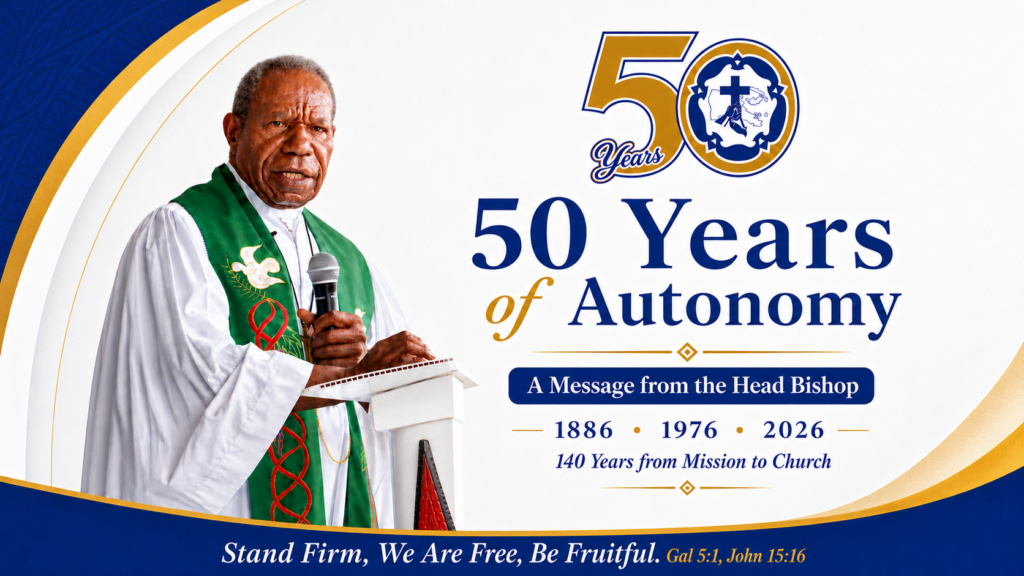
ELCPNG celebrates 50 years since the Declaration of Autonomy and 140 years of mission, witness and service in Papua New Guinea.
Theme: “Stand Firm, We Are Free, Be Fruitful.”
Galatians 5:1 | John 15:16
Anniversary Greetings to you all!
This year marks an important moment of our church, the Evangelical Lutheran Church of Papua New Guinea.
We celebrate a milestone journey of 50 years since the declaration of autonomy in 1976. The declaration was made a year after the country declared its political independence from the colonial powers.
This year also marks a milestone journey of 140 years of mission, witness and service for the ELCPNG in Papua New Guinea. It is a great moment to celebrate as church and as a nation. These remarkable journeys of 50 years as an autonomous church and 140 years of mission, witness and service in Papua New Guinea brought us this far.
Our traces of mission, witness and service go deep into the mountains, valleys, terrains and into the heart of isolated communities across the country wherever witnesses of Christ stepped foot. We have left lasting and impactful traces behind. Today the fire of the Lutheran faith and witness are still burning and keeping the communities, villages, clans and tribes much alive, intact and active from the towns to the isolated communities and from the lowlands to the highlands of PNG and from the mainland to the islands across the sea.
Mission growth and expansion
Today we look back and appreciate the fire of the Gospel ignited by John Flierl 140 years ago. The flame is bigger and brighter illuminating thousands of tribes across the country. The seed of the Gospel that was planted 140 years ago in Simbang area and became the second largest Christian denomination in the country with an estimated followers of two million people.
The declaration that was made in 1976 by our former leaders under the leadership of Bishop Sir Zwrewe Zurenuoc still echoes to this day. At the time when the declaration was made, the church had only seven districts. By 2003, ten more districts were added. It has grown to 17 districts, spreading across the country from the valley of Morobe to the mountains of Ialibu and Gilewe, from the islands of Siassi to the hinterlands of Menyamia, from the island of Karkar to the islands of New Britain and New Ireland. The seed of the Gospel keeps on growing and spreading from the ends of the mainland in Milne Bay to the boarder of West Sepik and Western provinces. Today mission continues to expand to the untouched isolated communities of Kambia behind the Kubo range, isolated communities of Wabo and Poroi along the Purari River behind Mt. Michael and Mr. Karamui, remote communities of Jimi and Ramu behind Mt. Wilhelm, isolated communities across the ocean in Bougainville and Manus. Mission continues and the fire keeps burring and will continue to spread.
We continue to hear beautiful stories of people who have been moved by faith to reach isolated places to transform communities and change people’s lives. Three days before the day of our celebration, I received a message about the progress of work in one of the remote workmisin areas.
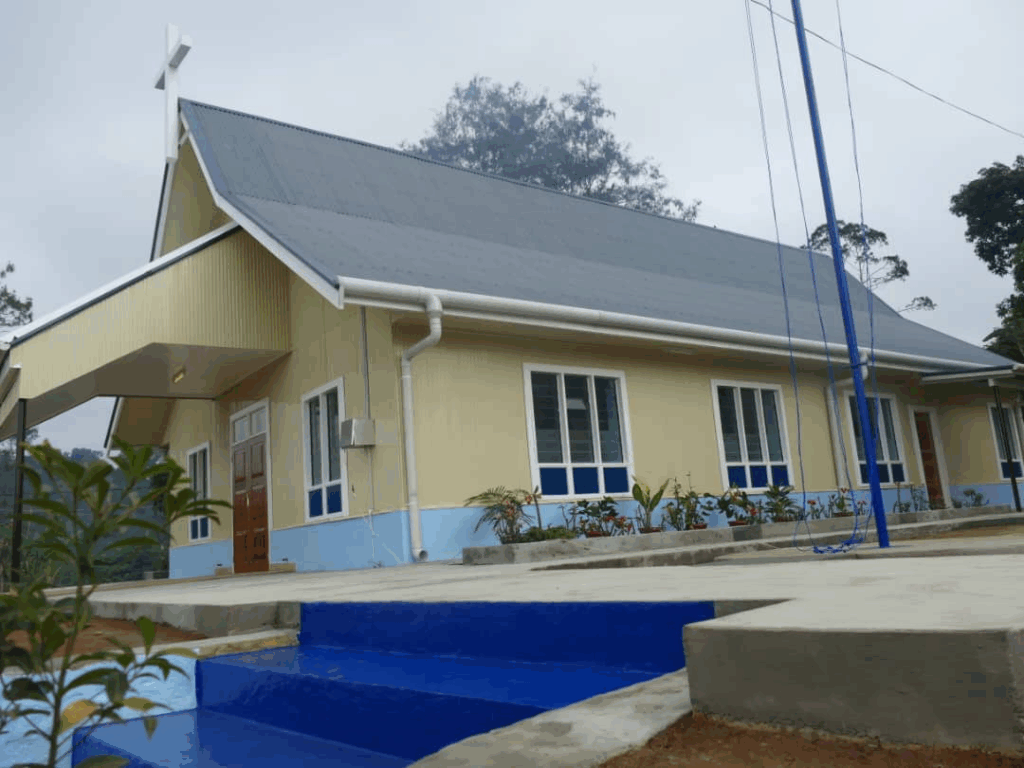
“… May our Good Lord shines his face over you all today and forever, Amen! Today is the final day of our boys in the jungle of Kambia mission Field to conclude the final touch on the Church building and tomorrow they will climb the mountains of Kubor range. Some students were with them there and returned home yesterday and reported. Glory be to God.”
(Gande Kutne, 08th July 2026).
They dismantled the chainsaw, put the parts in bags and carried them. They distributed the fuel for the machine in plastic containers and carried them. They walked and crossed rugged terrains with the loads on their body. Their mission was clear: to reach the untouched communities, touch their lives and build a church for them. This is an amazing story of progress and growth of mission to the isolated communities behind mountains and forest.
But they are not the first and not the last to climb mountains, not the first and not the last to cross rivers, not the first and not the last to put up with the challenge of rugged terrains, not the first and not the last to penetrate deep into the heart of isolated communities hidden behind thick mountains and dense forest, but they are indeed heroes of mission, following the footsteps of the many heroes who went before us through tough conditions to build this great church, which we celebrate today. Many who went before us have put up with so many challenges to connect isolated communities to the wider Christian community and to link up remote communities with western civilization and modern development of our nation.
As we celebrate the declaration of autonomy today, we must deeply reflect on such experiences of those who went before us and those who continue to go into remote places and isolated communities where many of us cannot reach in person. They are extension of God’s mission to touch lives with the Gospel of liberation, redemption and salvation.
On freedom
In the context of our celebration today the experiences I share brings us to the central theme of freedom which I want to reflect in my address. Freedom is a gift of God but we lost the freedom through disobedience. We are offspring of Adam and Eve, therefore we have inherited this nature of disobedience. By doing so we have allowed other forces to enslave us.
We have never been slaves in Egypt and Babylon like the Israelites but we have been slaves all our lives in different ways. Therefore, the Apostle Paul says we were still in our sins when Christ died for us. Christ liberated us from the bondage of sin, death and the power of the devil.
The same Gospel was brought to us here in PNG when we were still enslaved by many things. The Gospel transformed our communities and changed our lives. Our forefathers, grandparents and parents accepted the Gospel of peace, love and reconciliation. They were liberated and transformed; therefore, they passed onto us the same Gospel of liberation and the Christian values.
Now history is behind us but the traces of the past are around us everywhere. The Gospel we value, the church buildings we use, the faith we embrace and many other things we see or have today are traces of this beautiful history. The traces constantly remind us about our freedom, both our political and religious freedom.
We have been liberated from the colonial powers to an independent sovereign nation, from foreign dominance to self-determination, from no education to formal education, from no health services to hospitals and health centers, from no modern infrastructure to some form of infrastructures like bridges, roads, cities and towns, from the primitive age to the age of modern civilization, and from a simple agrarian life to the advance age of artificial intelligence (AI).
The Quest for freedom
Therefore, today we have gathered to celebrate freedom, the very gift of God, which we have forfeited in the beginning. However, after 50 years of political freedom and religious autonomy I speak about freedom with a heavy heart because many communities remain isolated in the remote places behind the mountains and jungle. Many people still remain enslaved and disempowered.
The Gospel has not reached them yet. They are not yet connected to the wider Christian community. They are still cut off from the modern world. There is no road link to connect them up to the rest of the country, there is no school to give their children a chance to education, there is no aid post or health center for treatment and delivery of babies, there is no network coverage for communication, there is no police post to maintain law and order, there is no modern judiciary system to maintain justice in the communities, there is no shop or market where people can buy or sell. They still live a simple basic life of fishing, gardening, hunting, planting and harvesting.
We must not forget them. They are part of us. They are God’s creation and needed the Gospel. They are citizens of this nation who need fair attention from the government. When they are still in their isolated world with little hope or no hope it is not freedom but enslavement, not hope but misery, not progress but stagnation, not enlightenment but despair, not empowerment but disempowerment.
The reality of enslavement
I speak from the perspective of freedom but at the same time, I am compelled not to be silent on the reality of enslavement and disempowerment. The Christian church is supposed to propagate the Gospel of liberation, redemption and salvation, yet in PNG, the Christian church appears to be a diving force. In the name of Christianity, many different groups emerge and preach Christ in one way or the other with one form of doctrine or another. By doing so they divide people and create confusion, rather than giving people hope and assurance of liberation. I believe there are more than 200 Christian groups in the country because our constitution permits freedom of religion. Freedom of religion is good but not the best for our country if freedom of religion promotes religious proliferation and disempower people.
I speak on freedom at the time when our country is experiencing many challenges. From lack of strong political leadership to devaluation of our Kina, rising level of law and order, violence in many different forms, employment, social disorder, family disintegration, economic inequality and many different forms of injustice in the country.
At the same time, corruption is killing our country. Millions of Kina meant to transform our communities, change the lives of our people and liberate them, went into the pockets and business accounts of few individuals at the top level while the majority at the bottom level suffer so much from lack of development and basic services. Patients go to the hospitals only to be told that medicine is not available or testing machines are not working. Children walk to school only to find that teachers are not in the classroom or basic textbooks are not available. People in the villages produce so much garden food only to find that their labour cannot be translated into cash value because there is no market or no transport to take their produce to the markets. Many students graduate with university degrees and college diplomas only to find that there is no job. Children grow up with a hope of a better future only to find that the future is gloomy or there is no future.
As we celebrate today, a mother is in labor in danger behind the mountains, because there is no health center. A father is walking for days to reach town because his family is in need. A child is begging on the street for food because he has no home. A youth is knocking on the door to find a job but there is no job. A girl is abused because family trust and protection is absent. A family is divided because there is domestic violence. A community is robbed of its peace because their is ethnic conflict. A mother is struggling to put food on the table because there is no money. A child cannot be enrolled in school because the school fee is too high for the family to afford. A mother is struggling to raise her children because the father has deserted them. A child is looking for warmth, love and peace because the family is broken.
This is not liberation but enslavement. This is not empowerment but disempowerment. This is not progress but stagnation and regression. This is not the PNG we would love to live in, but this is our reality we live with every day.
Challenges and hopes for freedom
We must ask ourselves again. What sense does it make as a nation to celebrate 50 years of political freedom when enslavement, disempowerment and regression continue to increase in the country, causing suffering for our people? What sense does it make to celebrate 50 years of autonomous ELCPNG when we cannot build on from the strong foundations laid by the missionaries with our own local capacities, local finances and local human resources?
We became an autonomous local church in 1956, almost two decades ahead of the country’s independence. We were leading the way on the path to decolonization, to localization, to self-determination, to self-governing and to more local responsibility and ownership. From 1956 to today, we are 70 years old as a local church. This year we celebrate the declaration made in 1976. We are older than the country’s political freedom. However, the challenge we have to fully realize our political and religious freedom remains an ongoing struggle. We must turn our challenges into opportunities for freedom and progress. 50 years must not be years of lost opportunities, lost resources, lost generations, lost vision and lost dreams for our church and for our nation. It must be 50 years of great lessons. Our challenges must become our motivation to rebuild the brokenness of our communities and transform the lives of our people.
Building a better future
Let us not see our challenges as obstacles but as opportunities for positive action and growth to build a vibrant church, a resilient society and a strong PNG. Building a healthy church, a strong resilient society and a strong country is our collective responsibility. Together with honesty and discipline, we can make our church a better church, our society a vibrant society, our country a strong country and create a better future for our children and the unborn children.
Our past reminds us to rethink our future. We must translate our ideas into products and our dreams into reality and create the future. We must shape the future, a better one than the one we live in today. Today we must not keep on talking about the future but we must create the future. The future we should aim to build must be a different one; not one that is filled with enslavement, disempowerment and suffering but one filled with hope, peace, justice and harmony. The future we want must not be a gloomy and fragmented one, but a brighter future with thriving communities, flourishing families, blooming society and a prosperous and progressive nation.
This is possible. It requires political will, personal will, as well as collective will with determination, discipline and positive action. As we celebrate today, we are empowered but also challenged to move on into the future with conviction, with strength, with new impulse in the spirit of solidarity and a renewed hope.
Conclusion
I conclude with three important focused areas late Bishop Zurewe Zurenuoc felt that they were important when autonomy was declared (P. Hauenstein, 2nd July, 2026).
1. Unity: In the midst of our social, religious and cultural diversities, let us preserve our unity as church and as a nation. Unity is our collective strength.
2. Autonomy: Autonomy goes with responsibly and commitment. The task of building up the church and the country is in our hands. Let us work towards shaping a better church and a better country for our people.
3. Spiritual growth: Growth and progress are necessary in the church and in our lives. Zurewe’s view of unity, autonomy and spiritual growth reminds us of our journey to freedom as we celebrate today.
We seek freedom because we have been liberated by Christ through grace (Galatians 5:1). Therefore, we must stand firm. As Luther says, here I stand! Here we stand! We stand for freedom, for peace, for justice, for a better church, a better ELCPNG and for a better PNG. As a church, as a society and as a nation, together we journey into the future with hope. May God lead us through!!!
Thankyou and I wish you all a joyful celebration!
Rt. Rev. Dr. Jack Urame (PhD)
Head Bishop
Thankyou Bishop Rt Rev Dr Jack Urame for this ckndtructive educational sermon from you to all the Lutheran faith followers of this beautiful country
naispela ripot